The $14.3 Million Lot That Explains Paradise Valley's Real Estate Market
September 17, 2026
September 17, 2026
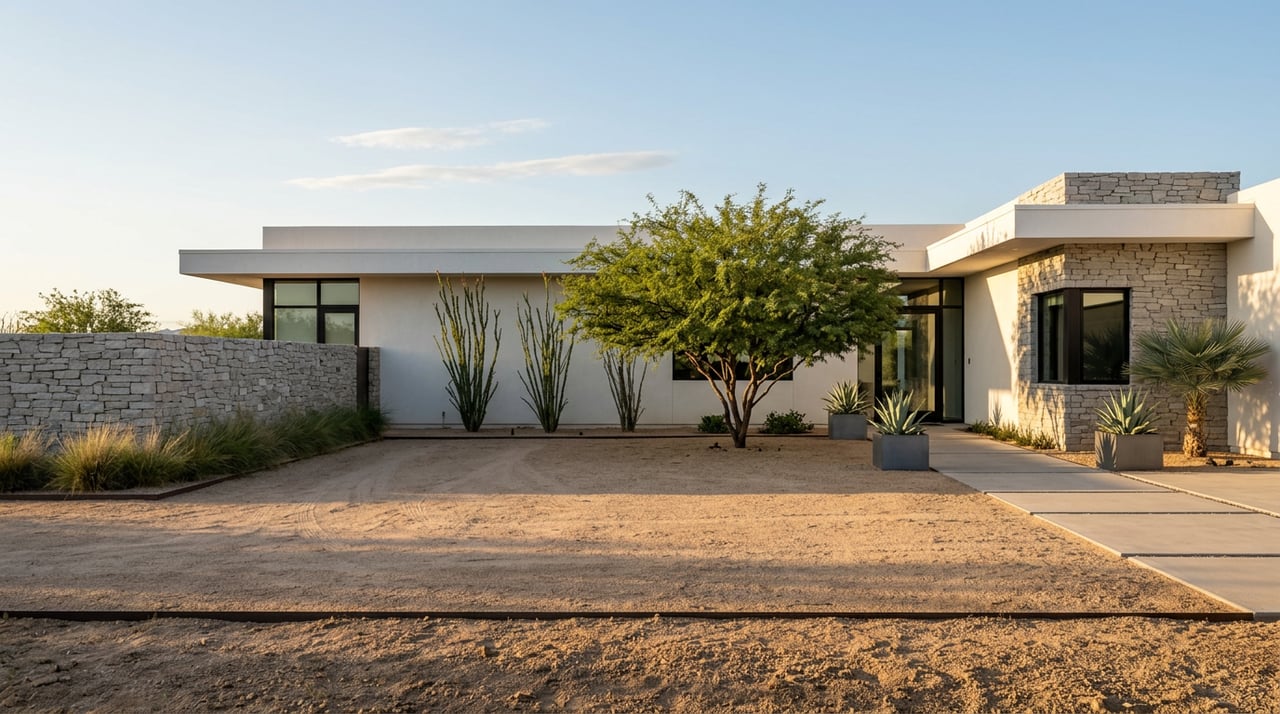
Reported in early February 2026, a 4.8-acre parcel on North Saguaro Road had changed hands for $14.3 million in cash. The nine-bedroom home already sitting on it was expected to come down. The buyer was an entity based in Bloomfield Hills, Michigan, according to public records, and wasn't purchasing square footage or a floor plan. According to Phoenix Valuations appraiser Andrew Turley, who tracked the deal, it was the highest price paid for a single parcel anywhere in Arizona up to that point in 2026, and it was a land sale in every sense that matters. The house was incidental.
That transaction is worth sitting with, because it contradicts what the rest of Paradise Valley's numbers were saying at almost the same moment. Redfin's data for the three months ending April 2026 showed the town's median sale price at $4.6 million, up 3.4 percent year over year, with homes moving slightly faster than the year before. But a more granular report on the 85253 zip code, tracking activity through June 2026 and built from that May's closings, told a different story: active inventory had jumped 42 percent in a single month to 431 listings, days on market had climbed to 121, and list prices had pulled back from $5.55 million in April to $5.25 million. The report's own conclusion was that this was the strongest buyer position in the zip code in eighteen months.
So which is it? Is Paradise Valley a market where a single parcel just set a state record, or one where sellers are sitting longer and cutting price? The answer is both, and understanding why is the actual education a buyer needs before cross-shopping this town against Arcadia or North Scottsdale.
Paradise Valley doesn't have one real estate market. It has two, and they behave almost independently of each other.
The first is the comps market: existing homes, many of them mid-century, priced and negotiated the way homes are priced everywhere, on condition, layout, and finish level relative to the asking number. This is the market where inventory is rising and days on market are stretching out. It's also the market that most listing portals and most median-price headlines are actually describing.
The second is the land market: parcels valued for what can legally be built on them, not what's currently standing there. This is where the Saguaro Road sale happened, and it isn't an isolated event. The adjacent parcel at 5600 North Saguaro sold for $11 million in 2022, and for nearly $7.8 million the year before that. Turley described the corridor as an area where land density already runs above the town's one-acre standard, with many lots between two and ten acres, which is precisely what makes it trade at a premium disconnected from the comps market next door.
| Signal | Comps Market (existing homes) | Land Market (premium parcels) |
|---|---|---|
| What's being priced | Condition, layout, finish level | Buildable envelope, zoning entitlement, lot size |
| Recent trend | Inventory up 42% month over month, days on market to 121 (May 2026 closings) | Record price per acre, cash, fast close |
| Who's buying | Move-in-ready buyers, more selective given added supply | Custom builders and relocating families planning to demolish or start fresh |
| Entry point | Mid-century homes trading closer to list-price sensitivity | Teardown lots starting near $229,000 land-only in the same zip code |
That entry point figure is worth pausing on. A $229,000 teardown and a $14.3 million land sale can both be true in the same zip code in the same year, because they're describing different products that happen to share a mailing address.
The reason land and structure separate so cleanly in Paradise Valley comes down to zoning, not taste. The town enforces a one-acre minimum lot size across most of its residential districts, a rule that dates back to its 1961 incorporation and has never loosened the way surrounding cities have. In the town's R-43 district, that translates to a minimum lot of 43,560 square feet with 165 feet of lot width, paired with a 25 percent floor-area ratio cap. Other districts, R-175, R-35, R-18, and R-10, carry their own versions of the same math.
Two review bodies sit on top of that zoning code, and either can shape what a buyer is actually allowed to build:
Because most of Paradise Valley never adopted the homeowners association model that governs newer subdivisions elsewhere in the Valley, this zoning and review structure is effectively doing the job an HOA would do in another town. A handful of guard-gated enclaves, among them Clearwater Hills, Finisterre, Judson Estates, Azure, and Paradise Reserve, do carry HOA dues for private gate staffing and shared landscaping. Outside those pockets, the town's own code is the governing document, and it's the code, not a homeowners board, that determines whether a given acre can support the home a buyer has in mind.
Put the zoning rules next to current pricing and a clear strategy shows up in the market. Land-only opportunities in the $2 million to $3 million range, paired with a custom build in the $5 million to $7 million range, land a finished asset around $8 million to $12 million, comfortably under the $15 million-plus trophy tier where competition and holding costs both intensify. That math is a meaningful part of why demand for organic-modern architecture in the Camelback Country Estates and Cherokee corridor has been rising this year. Buyers aren't stretching for finished trophy homes. They're pricing the land, budgeting the build, and treating the existing structure as a placeholder.
The buyers doing this math are disproportionately arriving from California, Illinois, and Washington, part of a wealth migration pattern that continues to push the top tier of pricing higher while the entry tier stays anchored by exactly the kind of dated mid-century homes that trade less on their own merits and more as land plays.
Paradise Valley gets grouped with Arcadia and North Scottsdale often enough that it's worth being precise about where the comparison breaks down. Both of those neighboring markets sit at meaningfully lower median price points, and in both, buyers are typically more sensitive to a home's actual condition and layout relative to their budget. That's a comps-market logic, the same one that governs most of residential real estate. Paradise Valley's land market operates on a different logic entirely, one where the zoning entitlement itself, not the house, carries the price. A buyer who understands only the comps-market rules will misread a Paradise Valley listing every time a premium lot is involved.
If you're comparing an existing Paradise Valley home against new construction or a teardown opportunity, the inventory jump reflected in that June 2026 report works in your favor on the comps side. There is more selection than the zip code has seen in a year and a half, and sellers of aging homes are adjusting list prices accordingly. But if the property you're evaluating includes size, elevation, or mountain proximity that puts it in the same category as the Saguaro Road corridor, the comps-market signals of softening demand and rising days on market simply don't apply. That parcel will be priced, and likely will sell, as land.
Getting that distinction right before you write an offer, or before you price a listing, is where a contract-fluent read on zoning and entitlement earns its keep. The difference between a $229,000 teardown and a $14 million legacy parcel isn't the roofline. It's the acre count, the FAR, and what the Hillside Building Committee will actually approve.
Does every Paradise Valley lot qualify as a teardown opportunity? No. The one-acre minimum and FAR caps apply broadly, but Hillside Building Committee review adds another layer wherever a parcel touches sloped or mountain-adjacent terrain, and outcomes vary by exact location and lot configuration.
Why does floor-area ratio matter more here than in most Valley cities? Because a 25 percent FAR on a one-acre lot sets a hard ceiling on how much house that acre can support, regardless of what a buyer might want to build. That ceiling is part of what keeps raw land valuable on its own.
Is the land-market pattern unique to the Saguaro Road corridor? That corridor is where the most recent record sale happened and where Turley noted density already exceeds the town's typical one-acre standard, but the same land-versus-structure separation applies anywhere in Paradise Valley where lot size, elevation, or entitlement outweighs the value of the existing home.
Paradise Valley rewards buyers and sellers who know which market they're actually in before they negotiate. If you're trying to figure out whether a specific property is a comps-market home or a land-market parcel wearing a house, that's exactly the kind of read Allison Cahill is built to give you. Schedule a confidential consultation to talk through what your budget actually buys in this town, acre by acre.
Detail-oriented, Cahill has a passion for studying the market and educating clients about current conditions, inventory and trends. “I take my time with each client and listen to what they want,” she says. “My sellers like that I truly market their properties on all social media platforms and print publications, with the use of not only photography, but also video, drone and 3D-style tours of their homes.”