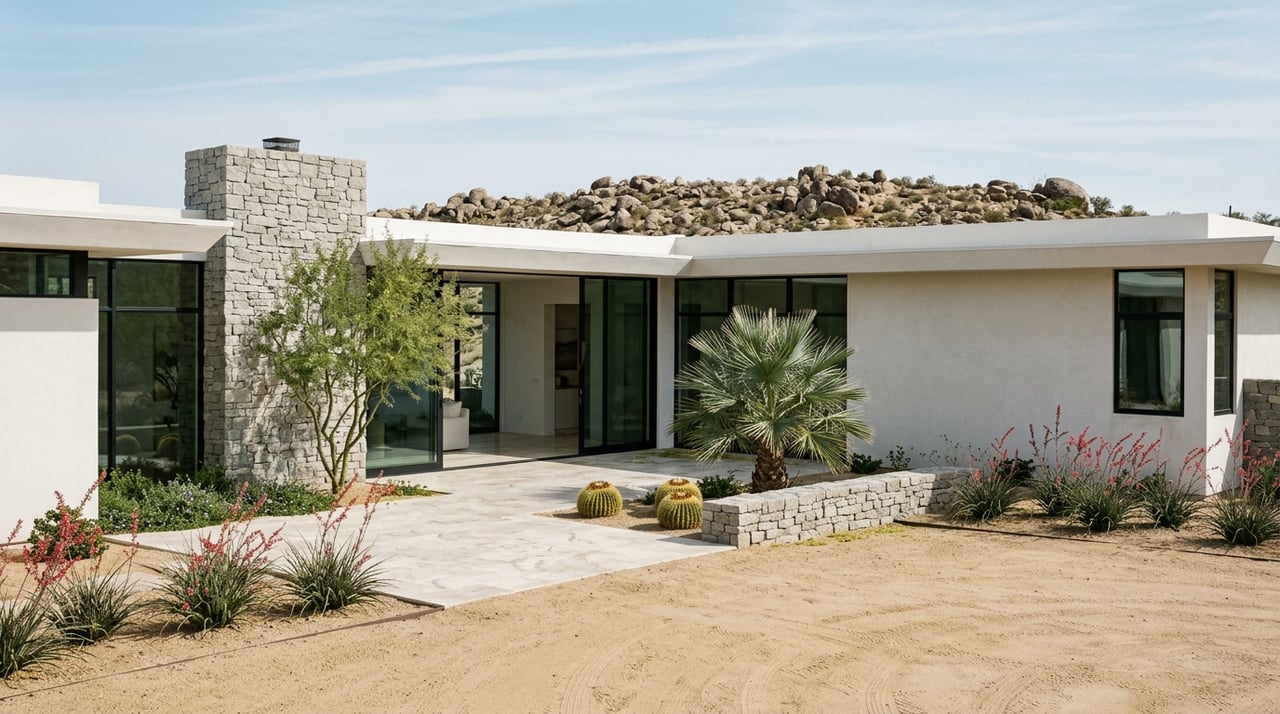
Carefree and Cave Creek Share a Border. Their Zoning Codes Explain Why They Don't Share a Price.
September 24, 2026
September 24, 2026
Pull four market trackers for Cave Creek, Arizona, and ask each one the same question: what did the median home actually sell for this year? You will get four different answers. Resideline's closing-price data, updated September 6, 2026, puts the trailing twelve month median at $1,089,000 across 152 tracked sales. Redfin's three-month window ending August 2026 shows $1.2 million, up 14.5 percent year over year. Zillow's Home Value Index, an average rather than a median, sat at $1,057,746 as of June 30, 2026. PropertyShark's second-quarter 2026 figure, drawn from 103 recorded deals, comes in at $855,000.
That is a $345,000 spread on the same town in the same year. It is not a data error. It is what happens when a market is small enough that a handful of unusual closings can move the whole number, and when every tracker counts a slightly different set of sales over a slightly different window.
The spread matters for a reason that has nothing to do with which tracker you trust. Carefree and Cave Creek get compared to each other constantly, both by buyers cross-shopping the Desert Foothills and by anyone scanning portal medians side by side. But the two towns do not set price the same way, and the mechanism behind each one explains more about what you are actually buying than the headline number does. Carefree's zoning code manufactures privacy and view corridors through minimum lot size. Cave Creek's zoning code ties acreage to legal use rights, meaning the number on the parcel report can determine whether you are allowed to keep a horse at all. A $1.3 million property in one town and a $1.3 million property in the other are not interchangeable products wearing different zip codes. They are two different legal instruments that happen to cost the same.
Part of why Cave Creek's median jumps around by tracker is that new construction and resale stock are getting blended into one figure when they should not be. In the 85331 zip code, roughly 30 active new-construction listings carry a median price near $2.775 million, well above the resale median in the same window. Toll Brothers is selling from its Sonoran Trails community, a gated single-level enclave on lots over 15,000 square feet, with pricing starting near $1.45 million. KLMR Homes is active nearby with Saguaro Trails and Forest Pleasant Estates. Both builders are adding inventory at a price point that has little in common with the older, wells-and-septic acreage that makes up most of the town's resale supply.
When a report's sample happens to include a run of new-construction closings, the town median moves toward $1.2 million. When it leans resale-heavy, it drifts toward $855,000. Neither number is wrong. Neither number tells you what a specific parcel is worth until you know which side of that line it sits on.
Cave Creek's residential code includes a category called Desert Rural, and inside that zone the acreage figure is not decorative. Under the town's zoning ordinance, private ranch use, meaning the right to keep horses, board them, breed, or run equine lessons, requires at least two contiguous acres under single ownership. Commercial ranch use requires at least five. Desert Rural minimum lot sizes in Cave Creek run 43,000, 70,000, 89,000, and 190,000 square feet, so a parcel can carry the Desert Rural label and still fall short of the two-acre threshold that actually unlocks horse use.
The ordinance keeps going past the acreage test. Total lot disturbance, the portion of a parcel a zoning reviewer counts as developed, includes driveways and septic systems, not just the house footprint. Fences, including corral fencing, must sit back at least 12 feet from any property line, and fences over four feet require a building permit. Manure storage has to sit at least 60 feet from every property line. Outdoor corrals and arenas cannot be lit past 10:30 p.m., and any permitted lighting is capped at 20 feet in height and must be shielded.
None of this shows up in a listing photo. A two-acre parcel with a septic field, a long gravel driveway, and a 12-foot setback on every side can leave meaningfully less usable ground than a buyer assumed when the acreage number first caught their eye. You can review the town's own zoning ordinance chapter on residential zones directly through Cave Creek's official site before you tour anything, and it is worth doing before you fall for a listing photo of an empty flat lot that photographs bigger than its buildable envelope actually allows.
A meaningful share of Cave Creek's rural stock runs on private well and septic rather than municipal water and sewer, and Maricopa County treats septic transfer as a documented event, not an assumption. If a property has an onsite wastewater system, the county requires a qualified inspection within six months before the transfer of ownership, and the buyer must file a Notice of Transfer within 15 calendar days after closing. Nobody mentions this at the open house. It surfaces in escrow, usually as a line item nobody budgeted time for, and it is one more reason the acreage-and-horses version of Cave Creek carries a different transaction rhythm than a comparably priced Carefree lot on town water.
Carefree builds its premium differently. Its zoning categories, ranging from Rural-190 down through R1-35, R1-18, and R1-10, control lot size and spacing rather than land-use rights, which is part of why so much of the town reads as estate-scale privacy rather than working acreage. A meaningful piece of Carefree's forward story, though, has been a promised retail center that would finally give the town something beyond The Boulders for daily convenience.
That project, known as Carefree Quarter, sits at the northeast corner of Carefree Highway and Cave Creek Road on land Empire Group of Companies has owned since 2017. In October 2024, the Carefree Town Council approved a five-year sales tax incentive agreement with developer CCS Crossroads, tied to Diversified Partners, for roughly 124,000 square feet of retail across 20-plus acres. The incentive, capped at $7 million, required at least 60,000 square feet built by the end of 2026. PetSmart signed on as an anchor. Trader Joe's was the developer's stated top target for a second anchor, though no lease was ever confirmed publicly. Initial tenants were slated to open by summer 2026.
One year after that agreement was signed, reporting from the Foothills Focus found nothing on the site but fencing. In April 2026, the Town of Carefree announced at a council meeting that Diversified Partners was out and a new developer, SimonCRE, was stepping in to work with the property owner. Mayor John Crane's response, as posted on the town's own site, was direct: "We are excited to be working with SimonCRE."
If part of what you are paying for in Carefree is the expectation of walkable retail arriving on a certain timeline, that timeline has already slipped once, publicly, with a change in developer. That is not a reason to avoid the town. It is a reason to price the amenity separately from the land, and to treat "opening soon" language in any listing or marketing material with the same scrutiny you would give a construction schedule anywhere else.
The instinct to compare Carefree and Cave Creek by median price treats them as two shelves of the same product. They are not. Cave Creek's price is partly a function of a legal document, its zoning ordinance, that determines what you are allowed to do with the dirt. Carefree's price is partly a function of a development agreement that has already changed hands once and still has no vertical construction to show for it as of this spring. A buyer comparing the two towns on medians alone is comparing two numbers that were built by entirely different mechanisms and happen to land in a similar range.
The more useful comparison starts with the actual document behind the price. In Cave Creek, that means pulling the zoning designation on a specific parcel and confirming whether it clears the two-acre threshold before assuming horse rights come with the address. In Carefree, that means asking what portion of the asking price reflects land and view versus a bet on retail that has not broken ground. Either question takes longer to answer than reading a median off a portal, and either one will tell you more about what you are actually buying.
Does every Cave Creek property have access to municipal water and sewer? No. Coverage depends on location. Areas closer to town center and planned communities are more likely to be on municipal service, while outlying acreage commonly runs on private well and septic, which changes both your closing checklist and your ongoing costs.
Is the Carefree Quarter site open for business yet? Not as of the Town of Carefree's most recent public update in April 2026, when the town confirmed a change in developer to SimonCRE. There is no confirmed public opening date at this time.
Comparing two towns that look alike from the road takes more than a spreadsheet of medians. It takes someone who reads the zoning ordinance and the development agreement the same way she reads a purchase contract. That is the work Allison Cahill does for buyers weighing Carefree against Cave Creek, and for sellers who need their listing priced against the document that actually governs it, not just the town average. Schedule a confidential consultation to talk through which parcel, and which set of rules, actually fits what you're trying to buy.
Detail-oriented, Cahill has a passion for studying the market and educating clients about current conditions, inventory and trends. “I take my time with each client and listen to what they want,” she says. “My sellers like that I truly market their properties on all social media platforms and print publications, with the use of not only photography, but also video, drone and 3D-style tours of their homes.”