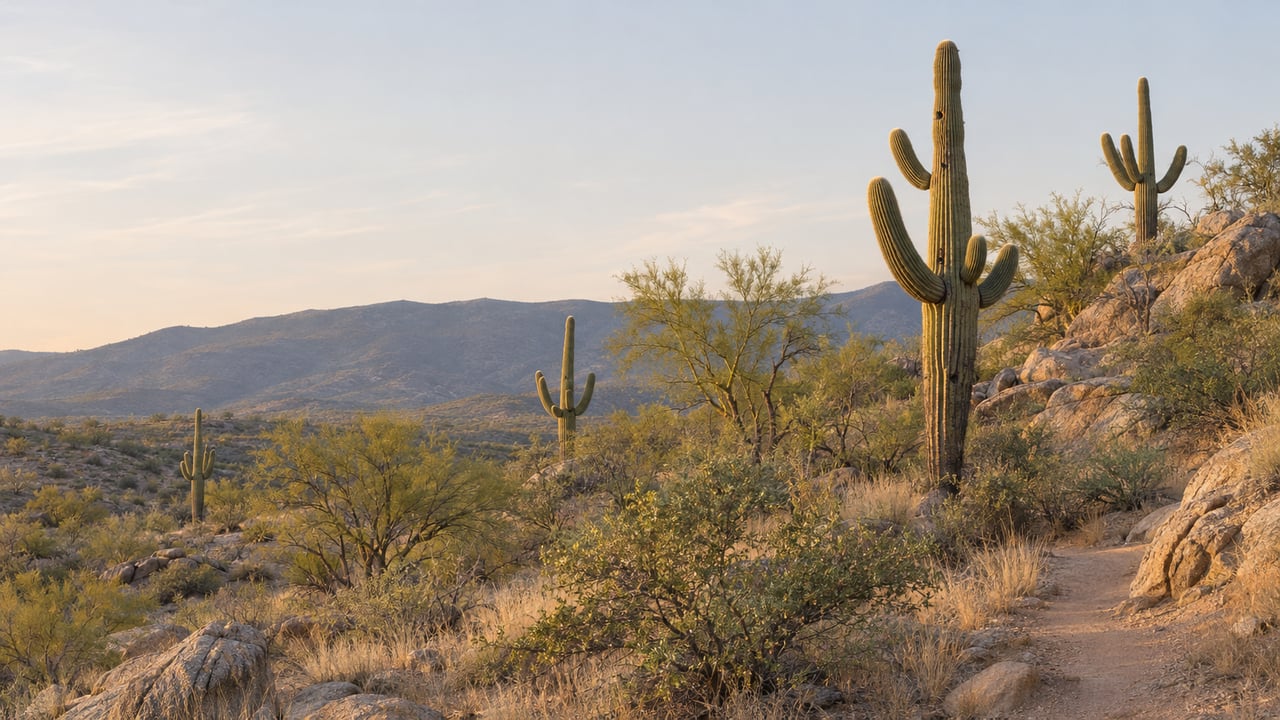
Cave Creek Voted to Keep 4,005 Acres Open. The Auction Comes Next.
November 12, 2026
November 12, 2026
Cave Creek voters approved Proposition 440, but the town does not own the 4,005 acres yet. What the vote created is a revenue stream. Starting January 1, 2027, the town collects an extra quarter-cent on taxable sales, and that money can be spent on one thing only. The land itself still goes through the Arizona State Land Department, which sells trust parcels like these at public auction. The minimum bid at that auction will come from an appraisal that hasn't been done yet.
So the hard part comes after the vote. The real test is the next year of surveys, studies and appraisal work.
As of its November 6 update, Maricopa County's unofficial election results showed Prop 440 passing with 2,017 yes votes, or 63.65%, against 1,152 no votes. The county reported 3,369 ballots cast in the town, a turnout of 78.09%. According to the Arizona Secretary of State's election calendar, the deadline for the Board of Supervisors to canvass is November 19, and the statewide canvass follows on November 23.
The measure got to the ballot through a signature drive, not a council referral. The Foothills Focus reported as much before the election. That origin explains the measure's design. A town task force had earlier worked out a different way to pay for the land, and the initiative went another way.
Under the ballot text printed in the Town of Cave Creek publicity pamphlet, Prop 440 adds a 0.25% sales tax, which comes to 1 cent for every $4 spent, on top of existing sales taxes. One pre-election quote circulated a 0.025% figure. The legal text says 0.25%. The town's September 2025 retail rate schedule lists Cave Creek's municipal retail rate at 3.00%, so the town's share of the tax moves to 3.25% starting January 1, 2027.
The restrictions in the measure matter more than the rate:
In practice, the tax pays for the land and nothing built on it. The ballot language quoted by The Foothills Focus spells out what the land is for:
"to protect in perpetuity natural living desert and mountains to maintain scenic views, as a habitat for wildlife and desert plants; to protect archaeological and historical resources and sites, while providing appropriate public access for educational purposes; and to provide limited outdoor recreational opportunities for residents and visitors."
That same text says the land "will be left in as pristine a state as possible" and will not contain traditional park facilities in all areas. The vote was about keeping the desert from being developed. It wasn't about building a new park.
The State Land Department's FAQ says trust parcels that are ready for sale must be sold at public auction, the minimum bid is the appraised value, and bidding continues until there is a winning bidder. Getting a parcel to auction starts with a $2,000 purchase application. ASLD's applications page lists its requirements, including a notarized certification, a parcel map, confirmation of access, and confirmation that the planned use fits local zoning.
The town already has an application in with ASLD. The September 15, 2026 council minutes record an update from Development Services Director Luke Kautzman and former Maricopa County Parks Director R.J. Cardin on the town's effort to acquire 405 acres of State Trust land for conservation, and they lay out the order of steps:
Step four will interest anyone who lives near that land. The conservation acreage in this application sits next to trust land planned for future homes, and the access routes for that land are being drawn now, as part of the same process.
The 4,005 Acres of Open Space campaign site, which carries the town's branding, estimates the auction for late 2027 and puts its value around $16 million, based on appraisals so far. The town's open space task force came in lower, estimating the land itself at $13.3 million. Its $16 million high-end figure added financing costs and a secondary property tax election, and the task force noted that the actual cost depends on the updated appraisal and the auction. The $2.7 million gap between those numbers is the range the new appraisal will settle.
The task force report never had the town buying all 4,005 acres alone. It recommended a joint purchase with Maricopa County Parks and Recreation and Desert Foothills Land Trust, with each partner taking parcels near land it already manages:
| Buyer in the task force plan | Parcels | Estimated share |
|---|---|---|
| Maricopa County Parks | Core Site and Apache Wash, adjacent to Cave Creek Regional Park | $4.6M |
| Desert Foothills Land Trust | Parcel #12, adjacent to the P.A. Seitts Preserve | $0.9M |
| Town of Cave Creek | Willow Springs and Rogers Wash | $7.8M |
The task force expected to cover the town's $7.8 million share with several sources: the Open Space Fund, projected at $2.5 million by mid-2026; $140,000 already held by the nonprofit FORCE; $1.5 million in federal matching funds; an estimated $2 million in private donations; and $1.66 million in non-reserved town funds. To repay any borrowing, its financing section modeled a secondary property tax. Prop 440 replaced that idea with a sales tax.
The report also sets a deadline. Under the current agreement, the partners have 14 years to complete the acquisition and must buy at least 160 acres in the first four. The county's role isn't settled. At the September meeting, Cardin described a September 7 session with the county manager, the assistant county manager, the parks director and Supervisor McGee. County leadership said it was willing to partner once the elections and budget questions settle.
Desert Foothills Land Trust has bought land from the state before. Its Jewel of the Creek Preserve page records a 2001 purchase of the 26-acre property from ASLD under the Arizona Preserve Initiative. That deal was 26 acres. This one is more than 150 times larger.
The acreage isn't one block. The Foothills Focus listed a dozen parcels ranging from 20 to 660 acres. Grouped by the landmarks residents already know:
The parcels group around Spur Cross and Cave Creek Regional Park, which explains the split in the task force plan. The county takes what borders its park, and the town takes the Willow Springs and Rogers Wash land around Spur Cross and to the west.
Until it's sold, this acreage remains State Trust land. ASLD requires a recreational permit for general recreation on trust land, $15 for an individual or $20 for a family. The permit covers hiking, horseback riding and bicycling, subject to closures and restrictions. Supporters wrote in the ballot pamphlet that existing public trails would be preserved, and the task force report describes possible trail links between the parcel areas. Because Prop 440 money can't pay for planning or maintenance, any new trail work would need other funding.
Every dollar donated before the auction is a dollar the town doesn't have to borrow. The campaign site reports $139,657 donated so far. Gifts are pooled toward the overall purchase and aren't assigned to individual parcels. Checks go to the Cave Creek Land Acquisition Account at PO Box 125, Cave Creek, AZ 85327, or can be dropped off at Desert Foothills Land Trust's office on Sidewinder Road. The task force had proposed giving levels named for local plants and animals, from Palo Verde at $40 to Mountain Lion at $400,000, and naming rights for donors large enough to fund an individual parcel. The report also noted that the federal Land and Water Conservation Fund can provide up to 50% of the cost when a municipality buys new land.
This post is general information about a public ballot measure. It isn't legal, tax or financial advice. If you're considering a donation or wondering how the new rate affects you, check your own situation with a qualified professional.
Open space that's protected next to a property, and trust land nearby that's slated for future homes, can both affect what that property is worth. If you'd like to talk through how the Prop 440 parcels and the coming appraisal relate to a home you own or are considering in Cave Creek, Allison Cahill offers confidential consultations.
Detail-oriented, Cahill has a passion for studying the market and educating clients about current conditions, inventory and trends. “I take my time with each client and listen to what they want,” she says. “My sellers like that I truly market their properties on all social media platforms and print publications, with the use of not only photography, but also video, drone and 3D-style tours of their homes.”